How to Know if Spanish Classes Are Working for Your Child (7 Signs of Real Progress)
- Jun 11
- 10 min read
Updated: Jul 19

Your child has been in Spanish classes for several months. They can count to twenty, name the colors, and sing a song about the days of the week. But when you ask them to tell you about their day in Spanish, you get a blank stare.
Is the program working? Or are you investing time and money into something that isn't actually building toward fluency?
This is the question almost every parent asks, and it's harder to answer than it looks. Language acquisition is invisible for long stretches. Progress happens in the brain before it shows up in speech, which means a child who looks stalled may be quietly building the foundation for a leap - or they may genuinely be spinning their wheels. Here's how to tell the difference.
Table of Contents
Why Progress Feels So Hard to Measure
Language learning doesn't move in a straight line. It moves in stages, and each stage has a different signature. A child in the early months is supposed to be mostly silent. A child in the second year may sound like they've plateaued when they're actually consolidating. Understanding that these stages are normal - and what each one looks like - is the foundation for evaluating any program.
Researchers have identified six sequential stages of language acquisition that every learner goes through, regardless of age or program type. There are no shortcuts from Stage 2 to Stage 5.
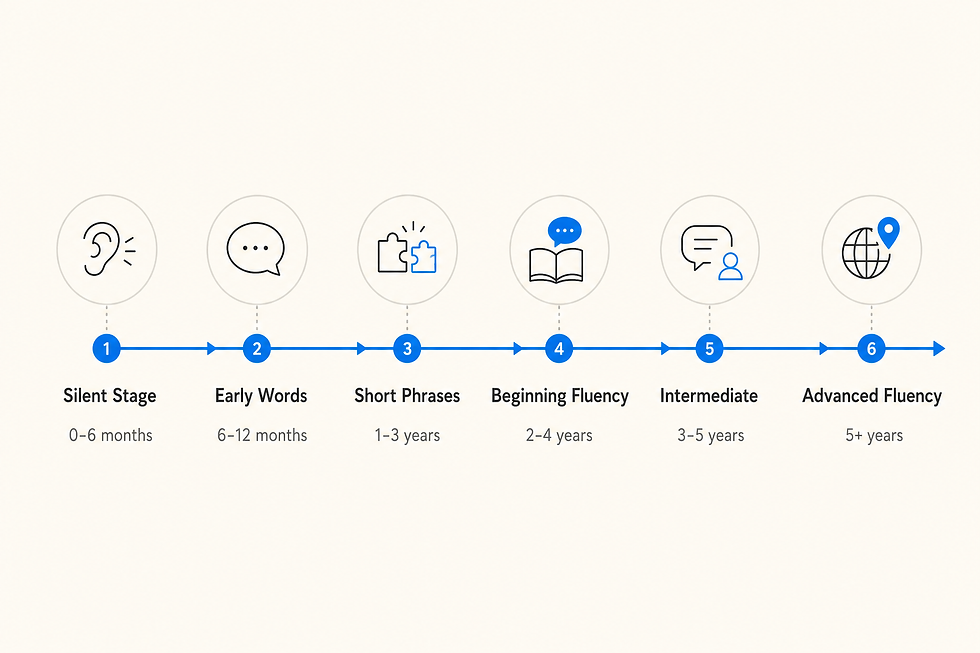
The 6 Stages of Spanish Language Acquisition
The first stage - sometimes called the Silent Period or Pre-Production Stage - lasts roughly six months for most children. During this time, a child who is genuinely absorbing language may say almost nothing in Spanish. This is completely normal and actually a good sign. What you're looking for in Stage 1 isn't output; it's comprehension. Does your child follow simple Spanish instructions? Do they respond to their name being called in Spanish? Do they laugh at the right moments in a Spanish cartoon?
Expecting your child to speak fluently after three months is like expecting them to run before they've learned to stand. Knowing which stage your child is in tells you whether to celebrate what you see or push for more.
What to Expect by Your Child's Age
The stage timeline above gives you the general framework. But how it plays out depends significantly on how old your child is when they start - and how many hours per week they're actually exposed to Spanish.
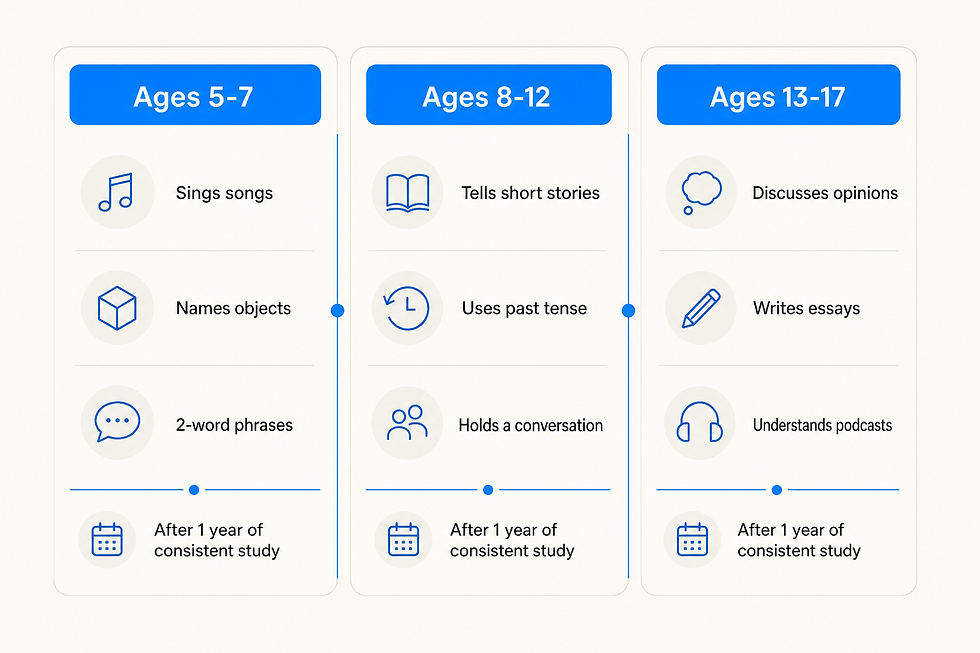
What to Expect by Age After 1 Year of Spanish Classes
Ages 5-7: Foundation Years
Young children are the most naturally receptive learners, but they're also the slowest to show explicit output. After a full year of consistent instruction:
Receptive vocabulary: 100-300 words. Your child understands simple routines, familiar songs, and one-to-two step instructions.
Expressive vocabulary: 50-100 words. Mostly single words, some two-word phrases like quiero agua or mi casa.
Key green flag: Child sings Spanish songs spontaneously - in the car, in the bath, unprompted. This signals genuine internalization.
Key red flag: Child can recite the word rojo on command but can't point to something red in the room. Recitation without comprehension is memorization, not acquisition.
To support this age group, research shows that 25+ hours per week of Spanish exposure produces native-like phonology. A weekly class plus Spanish cartoons at home is a realistic combination that most families can sustain.
Ages 8-12: The Critical Window
This age group represents what linguists call the optimal window for foundational literacy in a second language. Children this age can handle more complex instruction, and around ages 10-11, they start to think in Spanish - not just translate.
After a year of consistent instruction:
Receptive vocabulary: 500-800 words. Child follows short stories with visuals and multi-step directions in Spanish.
Expressive vocabulary: 200-400 words. Child forms simple sentences with subject, verb, and object. Attempts past and future tense (with errors - this is fine). Can tell a simple 3-5 sentence story about familiar topics.
Key green flag: Child participates in classroom discussions, not just answers direct questions. They're generating language, not just retrieving it.
Key red flag: After a year, child still relies on one-word answers or needs everything translated. This points to comprehensible input problems - the material may be too hard or too abstract.
Ages 13-17: The Speed Advantage
Contrary to popular belief, teenagers are not at a disadvantage when it comes to learning Spanish. They can't acquire native-like phonology as easily as a five-year-old, but their cognitive sophistication means they can make enormous vocabulary and grammar gains very quickly when motivated.
With intensive study - one hour or more per day - teenagers can achieve conversational fluency in six to twelve months. That's faster than younger children.
After a year of consistent instruction:
Receptive vocabulary: 2,000+ words. Teen understands podcasts, news segments, and complex narrative.
Expressive vocabulary: 1,500+ words. Teen discusses opinions, abstract topics, tells stories, and code-switches appropriately.
Key green flag: Teen can discuss their actual life in Spanish - their opinions, weekend plans, a movie they watched - not just scripted topics.
Key red flag: After a year, teenager cannot discuss their day or share a simple opinion beyond very basic sentences. At this age, with cognitive capacity to accelerate, flat progress strongly suggests something is off - whether it's motivation, method, or engagement.
The Green Flags: Signs the Program Is Really Working
These are the signals that distinguish genuine language acquisition from memorization. You don't need all of them, but you want to see several consistently appearing over time.

Green Flags vs. Red Flags in a Spanish Program
Your child initiates Spanish use without being asked. This is the single strongest signal. When a child volunteers Spanish - with a sibling, a pet, or just narrating their own play - it means the language feels like a tool, not a homework assignment. Voluntary use signals intrinsic motivation and genuine acquisition.
Your child code-switches. Code-switching is when a child mixes Spanish and English in the same sentence: "Mamá, can you pass me la mantequilla?" Parents often worry this means confusion, but researchers have documented that code-switching reflects cognitive flexibility and demonstrates both languages are genuinely active in the brain. It's a feature, not a bug.
New words show up at home that weren't in the lesson. When a child starts using vocabulary they picked up from a Spanish story, show, or conversation - words you never explicitly taught them - that's comprehensible input working exactly as it should. Language is being absorbed through context, not memorized from a list.
Your child responds to unexpected Spanish prompts. Ask your child a question slightly different from what they've practiced. If they can handle it, they're acquiring the language. If they can only answer the exact questions from their lesson script, they're memorizing it.
Your child gets frustrated when they can't express something in Spanish. This sounds like a problem but it's actually a powerful green flag. Frustration means your child wants to communicate in Spanish and feels the gap. That drive is what powers acquisition forward.
Pronunciation sounds increasingly native-like. This is especially meaningful for children under ten. If your child is replicating Spanish phonemes - the rolled r, the open vowel sounds, the rhythm of the language - they're being exposed to genuine comprehensible input from native speakers, and their brain is mapping the sound system accurately.
The Red Flags: Signs to Take Seriously
These patterns don't necessarily mean you need to pull the plug immediately, but each one is a signal worth investigating.
Vocabulary stays frozen. Your child can recite the same twenty words they learned in month one, in the same order, but can't use them flexibly. Reciting "rojo, azul, verde, amarillo" in order is memorization. Pointing to a blue car you just drove past and saying azul unprompted is acquisition.
Zero voluntary use after months of classes. If your child only ever speaks Spanish when directly instructed - never spontaneously, never playfully, never in the margins of daily life - the language feels like a chore. The affective filter, a concept developed by linguist Stephen Krashen, suggests that stress and anxiety literally block language acquisition. A child who dreads Spanish class is learning despite their program, not because of it.
Comprehension has stalled. If your child understood simple instructions six months ago and still can't handle slightly more complex ones today, the input level isn't right. The material may be too hard, too abstract, or delivered in a way the child can't follow. Stalled comprehension almost always means input isn't truly comprehensible.
Your child understands but refuses to speak. A child who has strong receptive vocabulary but minimal expressive vocabulary is at risk of becoming what linguists call a receptive bilingual - someone who understands the language but never develops the active skills to use it. Programs need to create opportunities for forced output, not just comprehension exercises.
The program relies heavily on translation. If every explanation is immediately given in English, the brain learns to wait for the English version instead of working to understand the Spanish. Heavy translation is one of the clearest signs that a program isn't using comprehensible input methods.
Your child can perform grammar rules but not use them. Knowing that ser is for permanent states and estar is for temporary ones is not the same as using either one correctly in a real conversation. Grammar rules memorized for tests rarely transfer to spontaneous speech without deep immersion.
How to Assess Your Child at Home (Without Being a Tester)
You don't need to administer a formal exam. These simple activities tell you a lot:
The shopping list test. Ask your child to help you make a shopping list in Spanish. This requires vocabulary in context, not recitation. A child who's genuinely acquiring will pull from multiple lesson sources. A memorizer will freeze.
The unexpected question test. Ask a question slightly outside what they've been studying. "What did you have for lunch today?" or "Tell me about your best friend." If they can handle it, even imperfectly, they're acquiring. If they need the question to match exactly what they practiced, they're memorizing.
The Spanish TV test. Put on an age-appropriate Spanish-language show or YouTube video - not from their class, something new - and watch their engagement. Are they following it? Laughing at the right moments? Asking questions about what happened? Engagement with authentic content that wasn't designed for their specific lesson is a strong signal.
The narration test. Ask your child to tell you what happened in their Spanish class today, or describe a favorite game, using Spanish as much as they can. Don't correct; just listen. Are they generating sentences, however imperfect? Or only producing isolated words when prompted?
How Long Does Fluency Actually Take?
This is the question parents most want answered, and the honest answer is: longer than most programs suggest in their marketing, but shorter than most parents fear with a good program.
Researchers estimate that basic conversational fluency requires approximately 300 hours of direct conversation practice. At one 45-minute session per week, that's roughly eight years. At one hour daily with media supplements and an online class, you're looking at two to three years for solid conversational ability.
The variable that moves the needle most is consistency plus total exposure. Regular 15-30 minute daily sessions outperform sporadic longer sessions. Spanish cartoons, music in the car, a short bedtime story in Spanish - these accumulate into hours that compound over months and years.
Full fluency - the kind where your child can navigate any topic in Spanish with comfort - typically requires five to seven years of sustained, meaningful exposure. That's a long-term investment. The good news is that families who approach it that way, rather than expecting quick results, tend to stay consistent and actually get there.
Understanding Proficiency Benchmarks
If you want a more formal lens on your child's progress, two frameworks are widely used by language educators worldwide: ACTFL (American Council on the Teaching of Foreign Languages) and CEFR (Common European Framework of Reference).

The CEFR Proficiency Scale
The CEFR scale runs from A1 (complete beginner) to C2 (mastery). For practical reference:
A1-A2: Child understands and uses familiar everyday expressions; can introduce themselves; handles very basic interactions.
B1-B2: Child can handle most travel situations, describe experiences and events, and give opinions on everyday topics with some fluency.
C1-C2: Child uses language flexibly and effectively for social, academic, and professional purposes; expresses themselves spontaneously with precision.
For most children in online programs with one to two classes per week and modest home exposure, reaching A2 after one to two years is a realistic target. B1 typically takes two to four years with consistent effort. These are not small achievements - A2 in Spanish is genuinely useful in everyday life.
ACTFL research on K-16 language learners found that students who complete four or more years of traditional classroom study typically reach Novice-High to Intermediate-Low. Students in immersion programs or advanced classes can reach Intermediate-Mid to Advanced-Low in the same period. These are the goalposts a good program should be moving your child toward.
What to Do If the Program Isn't Working
If you're seeing multiple red flags consistently over several months, here's how to think through it:
Talk to the teacher first. Ask specifically: "What stage of acquisition is my child in? What would you expect to see after another three months? What can I do at home to support progress?" A teacher who can answer these questions concretely and specifically is worth your investment. A teacher who gives you vague reassurances is not.
Audit the method. Is the program teaching through stories, visuals, and genuine comprehensible input? Or is it primarily grammar drills, translation exercises, and vocabulary memorization? Programs rooted in comprehensible input consistently outperform grammar-focused instruction in speaking proficiency. Method matters more than frequency.
Look at the engagement level. A joyless program is an ineffective program, regardless of the curriculum. Anxiety and low self-esteem create what Krashen called a high affective filter - a psychological barrier that blocks language input from being absorbed. A child who dreads class needs a different environment, not more homework.
Add input at home. Even if the program itself is solid, limited exposure is the most common culprit for slow progress. Spanish cartoons, Spanish music, Spanish-language picture books for younger kids, or Spanish-language YouTube for older ones - these don't feel like studying, but they add the hours that compound into fluency.
Give it more time. If you're in the first six months and the main signal is silence, that may simply be the Silent Period doing what it's supposed to do. Hold evaluation for month nine or twelve before drawing conclusions.
The Bottom Line
Measuring your child's Spanish progress isn't about quizzing them on vocabulary lists. It's about watching for voluntary use, real comprehension, and the gradual emergence of a child who reaches for Spanish not because they have to, but because they want to.
The green flags - code-switching, spontaneous use, new words appearing from nowhere - are the evidence you're looking for. The red flags - frozen vocabulary, avoidance, a blank stare at real Spanish - are the signals to act on.
Fluency is a long game. The families who get there aren't the ones who found a magic program; they're the ones who chose a solid method, stayed consistent over years, and kept Spanish present in daily life in small, sustainable ways.
If your child is somewhere in the middle - genuinely making progress but not yet where you hoped - that's probably exactly where they should be. Stay consistent, add exposure where you can, and trust the process.
If you're ready to take the next step, we'd love to help. We offer online Spanish programs for students ages 5–18, designed to build confidence, encourage real communication, and support long-term fluency.
🎉 Schedule a FREE trial lesson today and discover your child's path to Spanish fluency.


Comments