One-on-One vs Group Spanish Classes for Kids: Which Is Best for Your Child?
- Jul 20
- 9 min read
Updated: 2 days ago
Comparing one-on-one, small group, and large group Spanish classes for kids - what the research says and how to choose the right fit for your child.
TL;DR
Your child learns Spanish by speaking, listening, making mistakes, and building confidence — not just by memorizing vocabulary.
The class format you choose can shape how much practice and support your child receives.
One-on-one Spanish classes provide the most personalized attention, more speaking opportunities, and lessons adapted to your child's goals and pace.
Small group classes (4–6 students) offer a balance of personalized learning, peer interaction, and affordability.
Large group classes are the most budget-friendly option and can be a great introduction to Spanish, but students typically receive less individual attention and conversational practice
There is no "right" choice for every child. The best option depends on your child's personality, goals, schedule, and how they learn best.
You want more than your child passing a test — you want them to confidently use Spanish in real life.
Let's look at each option honestly so you can choose the learning environment where your child will thrive.
Table of content
How the three formats compare
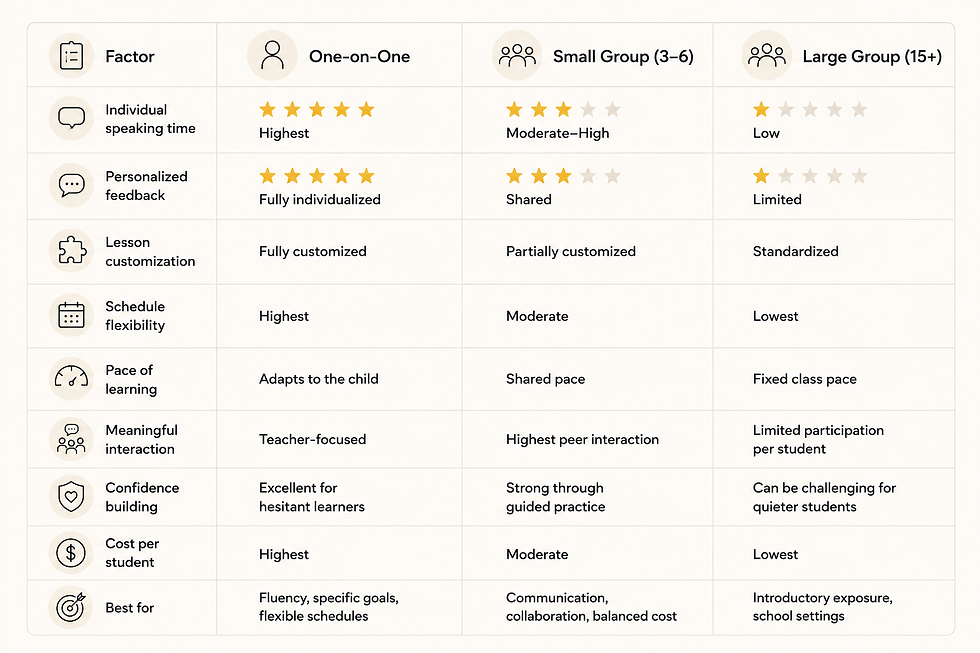
Before diving into each format, here's a side-by-side look at what actually differs between them:
One-on-one Spanish classes
What makes individual instruction work
In a one-on-one class, your child and the teacher spend the entire lesson in conversation. There's no waiting for a turn to speak, no sitting through someone else's question, no lesson paced for the slowest or fastest student in the room.
More opportunities for meaningful interaction are widely considered an important ingredient of successful language learning.
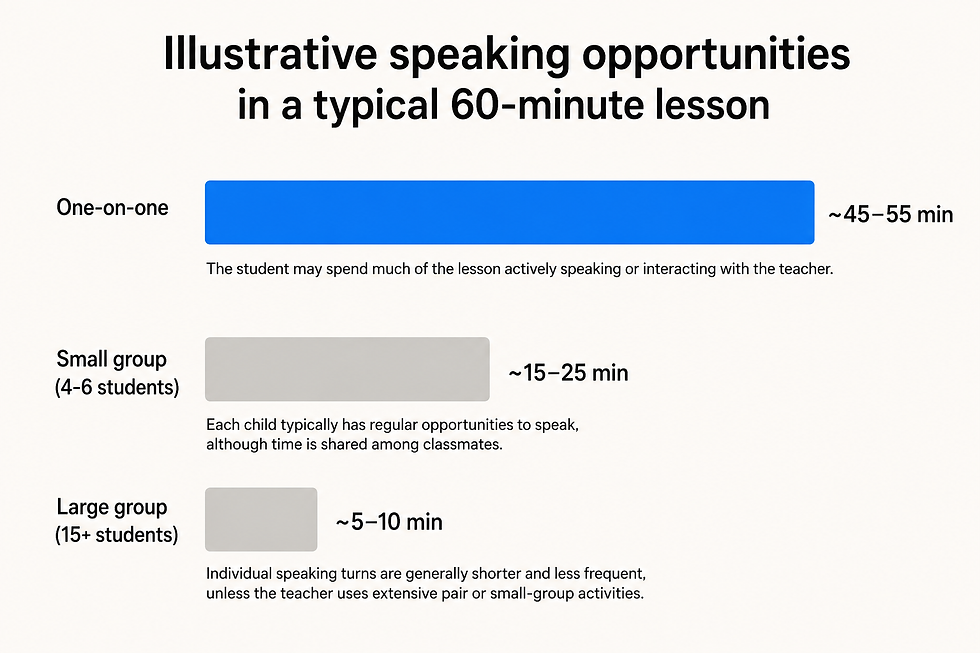
The exact amount of speaking depends on the teacher, lesson design, and use of pair or group activities, but as class size increases, each student's opportunities for individualized interaction and feedback generally decrease.
The second advantage is personalization. A skilled teacher can calibrate every activity to more closely where your child is - what Stephen Krashen's input hypothesis calls i+1: language that's just one step beyond the learner's current level. In a group, the teacher targets the middle of the room. Some kids are bored, some are lost. In one-on-one, every moment of every lesson is targeted precisely at your child.
The confidence factor
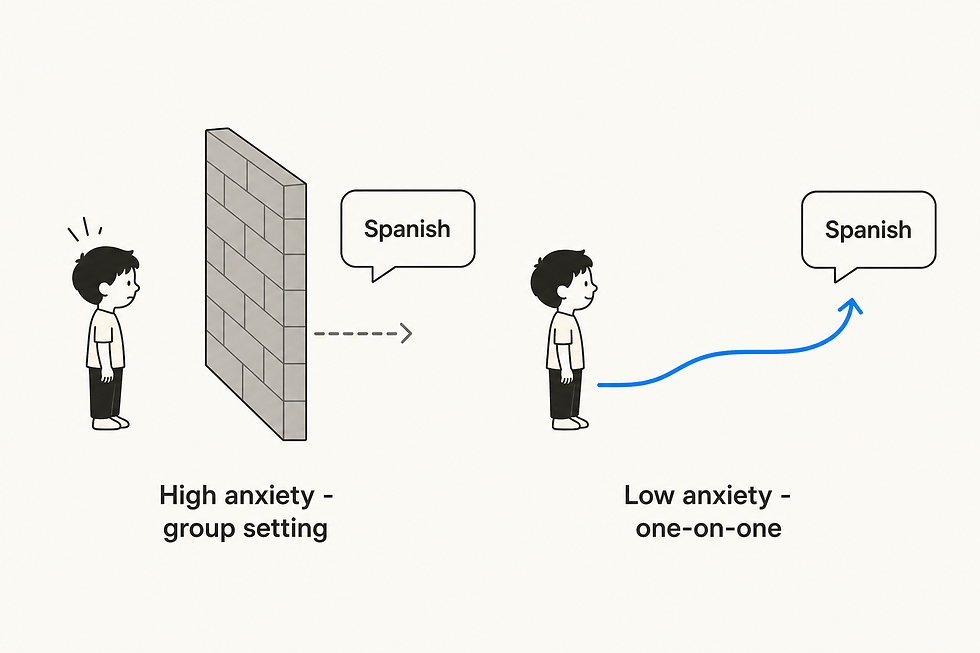
For children who are naturally shy, easily embarrassed by mistakes, or anxious about performing in front of peers, this format is transformative. Krashen's affective filter hypothesis suggests that anxiety and fear of making mistakes can interfere with language acquisition. For some children, smaller classes or one-on-one lessons may create a lower-pressure environment that encourages them to participate more.
When there's no audience, the stakes of making a mistake drop to zero. Kids try things. They mispronounce words, laugh, and try again. That's where fluency actually gets built.
Drawbacks
Cost. Individual sessions cost significantly more than a spot in a group class. This is the most common reason families don't start here.
Less peer interaction. Your child practices with one person. There's no social dynamic, no peer learning from hearing classmates' questions and mistakes.
Requires the right teacher. The quality ceiling is higher - but so is the floor when the match isn't right. A mediocre one-on-one teacher underperforms a skilled group instructor.
Best for
Children who want to become fluent within a specific timeframe.
Children who need to take classes at different times each week because of changing school, sports, or family schedules.
Kids who are shy, introverted, or anxious about speaking in front of others.
Children preparing for a specific goal, such as a family trip, an exchange program, admission to a bilingual school, or a Spanish proficiency exam.
Learners who need a faster or slower pace than a group class can provide.
Students who have fallen behind or want to accelerate beyond their current level.
Kids who are easily distracted in larger groups and learn best with focused instruction.
Small group Spanish classes
What this format gets right
Small group classes (typically 4-6 students) offer something one-on-one instruction genuinely can't: the social energy of learning alongside peers. Children hear others make mistakes - and realize mistakes are normal. They learn from each other's questions. They build shared vocabulary in a collaborative way.
Research comparing class size and language proficiency suggests that smaller classes can create more opportunities for participation, feedback, and interaction. These advantages are especially important in language learning, where students need frequent opportunities to use the language.
For extroverted children, the social context is genuinely motivating. Some kids simply work harder and stay more engaged when there's a group dynamic.
Drawbacks
Less personalization. The teacher has to balance the needs of multiple learners. Your child's specific gaps or interests won't always drive the lesson.
Less speaking time. Even in a small group, opportunities to speak are divided. A 60-minute class with five students gives each child around 10-12 minutes of individualized practice
Pacing compromises. If your child moves faster or slower than the group, the class may not be the right speed.
Best for
Social children who enjoy learning and practicing with peers.
Families looking for a balance between personalized instruction and affordability.
Children who are already somewhat confident speaking and benefit from regular conversation practice.
Learners who see language learning as both a social experience and an academic skill.
Families who can commit to a consistent, fixed weekly schedule.
Children who are motivated by collaborating, playing, and communicating with classmates while still receiving meaningful opportunities to participate.
Large group Spanish classes
The honest picture
Large group classes - 15 or more students - are the format most families are familiar with, whether through school, community programs, or popular online platforms. They're affordable, accessible, and easy to find.
ACTFL's formal position statement on class size identifies large classes as a structural challenge for language learning. The core problem: one teacher, many students. The teacher has fewer opportunities to have real one-on-one conversations in the target language. Feedback on pronunciation is rare. The child who's confused sits quietly rather than risk asking a "dumb" question in front of peers. The child who already knows the material waits.
A 2018 systematic review by Filges, Sonne-Schmidt, and Nielsen found small positive effects of reducing class size on academic achievement overall. Although the review was not specific to language learning, smaller classes may provide more opportunities for individualized feedback and participation—two factors that are especially relevant when learning to communicate in another language.
Drawbacks
Minimal opportunities to speak per student. In a 60-minute class with many students, each child may only have a few minutes of individual speaking time, depending on the activities and teaching style.
No personalization. The lesson is designed for the average student, not your child.
Higher affective filter. Making mistakes in front of 15 classmates is genuinely scary for many children. Some stop trying to speak at all.
When it makes sense
Large group classes can be a good option for early, low-pressure exposure to Spanish. They introduce children to the sounds, vocabulary, and rhythm of the language and can help spark interest before moving to a more intensive learning format. They're also a practical choice when budget is the primary consideration and some structured exposure is better than none.
However, if the goal is conversational fluency, large group classes often have limitations. With many students sharing class time, each child typically has fewer opportunities to speak, receive personalized feedback, and practice real conversations. Many families aiming for fluency choose smaller groups or one-on-one lessons, or supplement large classes with additional speaking practice.
What the research says
The evidence across second language acquisition (SLA) research points consistently in one direction: language is learned by doing it, and doing it means speaking, producing, making mistakes, and getting feedback. Formats that maximize that cycle produce better results.
Three SLA principles are especially relevant:
1. Comprehensible input (i+1). Krashen's input hypothesis holds that acquisition happens when learners receive input just beyond their current level. One-on-one instruction allows exact calibration. Group instruction targets the middle.
2. Output and production. Merrill Swain's output hypothesis found that listening and reading alone aren't enough - learners need to produce language to build accurate grammar and fluency. Producing language gives learners opportunities to notice gaps in their knowledge and receive feedback, which can support language development.
3. The affective filter. Anxiety, low confidence, and fear of embarrassment block acquisition. Krashen's affective filter hypothesis explains why some children stop trying to speak in group settings: the social risk is too high. One-on-one eliminates that risk.
ACTFL's research also identifies target language use - recommends maximizing meaningful use of the target language during instruction, with teachers using Spanish as much as possible while still supporting student understanding. In larger classes, teachers often need to devote more attention to classroom management and balancing multiple learners, which can reduce opportunities for individualized conversation.
How to choose the right format for your child
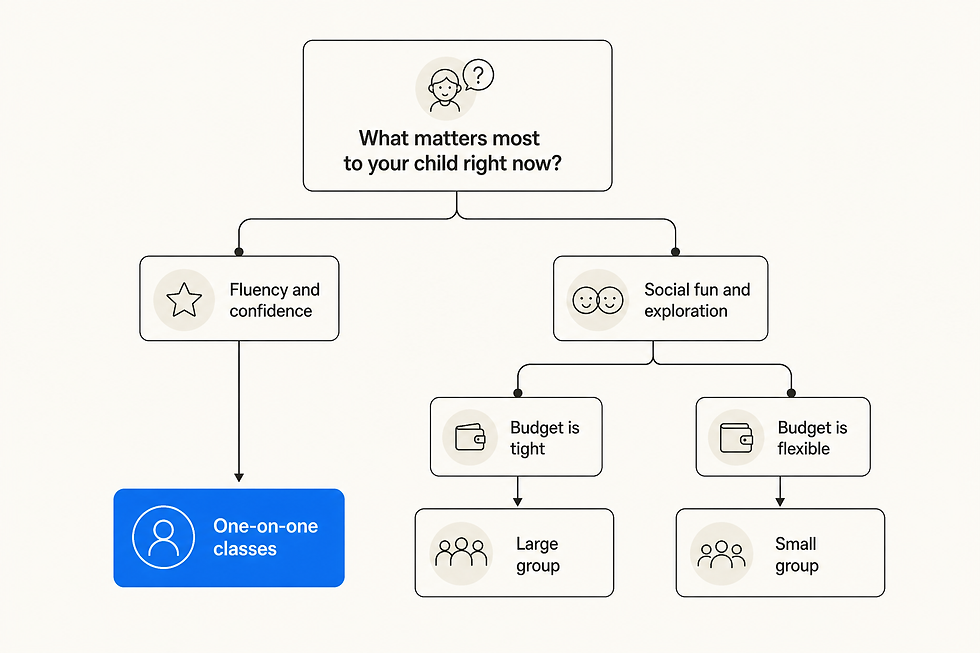
There is no single right answer. The best format depends on your child's personality, your goals, your schedule, and your family's priorities. Here is a practical framework to help you decide:
Choose one-on-one classes if:
Your child is shy, anxious, or has struggled with confidence in group settings.
Your child needs to move faster or slower than the pace of a typical classroom.
You are preparing for a specific milestone, such as a family trip, a bilingual school, an exchange program, or connecting with Spanish-speaking relatives.
Your child benefits from building a consistent relationship with a trusted teacher.
Your family needs flexible scheduling because your weekly routine changes.
Choose small group classes if:
Your child enjoys learning with peers and is motivated by social interaction.
You want a balance between personalized attention and affordability.
Your child enjoys participating in conversations, activities, and collaborative learning.
The social experience of learning Spanish is as important as developing the language skill itself.
Your family can commit to a consistent weekly schedule.
Choose large group classes if:
Budget is the main consideration and you want to provide your child with structured Spanish exposure.
Your child enjoys group environments and does not require frequent individual feedback.
Consider combining formats.
Some families choose regular one-on-one lessons for individualized instruction, while others enroll their children in larger group classes. In either case, reading, writing, or conversation clubs can be a valuable complement. For children in larger classes, clubs create additional opportunities for active language use in a more interactive setting. For those learning one-on-one, clubs provide meaningful opportunities to practice with peers, build confidence, and develop social connections. For many learners, this combination creates a well-rounded language learning experience that balances personalized support with collaborative practice.
At Helping Kids Learn Spanish, we believe that meaningful language learning extends beyond the classroom. That's why every active student ages 8 and up receives free access to our Spanish Conversation Club. Whether your child takes private lessons or learns in a small group, the Conversation Club provides extra opportunities to speak Spanish in a relaxed, supportive environment, make friends with other learners, and build the confidence that comes from using the language in real conversations.
Not Sure Which Spanish Class Format Is Right for Your Child?
Every child learns differently. Some children thrive with personalized one-on-one instruction, while others gain confidence by practicing with peers in a small group.
The first step is discovering what works best for your child.
In a free trial lesson, your child can experience a real Spanish class, practice communication skills, and you can learn more about the best program based on their age, level, goals, and learning style.
Don't spend months wondering if a program is the right fit. Let your child try Spanish, meet their teacher, and start building confidence from day one.
👉 Book your free trial lesson today and take the first step toward helping your child become confident and comfortable speaking Spanish.
Frequently Asked Questions
What is the best way for kids to learn Spanish?
There is no single best format for every child. The most effective approach depends on factors such as the child's age, personality, motivation, goals, and opportunities to use Spanish outside of class.
One-on-one Spanish lessons can be highly effective because they provide more individualized practice, personalized feedback, and instruction adapted to the child's pace.
Small group classes can also be valuable because they provide peer interaction and opportunities for communication.
The best choice is the format that gives your child consistent, meaningful exposure to Spanish and keeps them motivated to continue learning.
How much speaking time does a child get in a group Spanish class?
The amount of conversational practice varies greatly depending on the class size, teacher, lesson design, and activities used.
In larger classes, each student generally has fewer opportunities to speak compared with one-on-one lessons because class time is shared among more learners. For example, in a 60-minute class with many students, each child may only have a limited amount of individual opportunities to speak.
In a one-on-one lesson, the entire session can be focused on the learner, allowing for more conversation practice, immediate corrections, and personalized instruction.
Over time, these differences in speaking opportunities can have a significant impact on language development.
Are online Spanish classes for kids effective?
Yes, live online Spanish classes can be effective when they include an experienced teacher, meaningful interaction, and opportunities for students to actively use the language.
The benefits of online learning are similar to in-person instruction when the learning experience is designed well: personalized feedback, conversation practice, and consistent exposure to Spanish.
The key factor is not simply whether a class is online or in person, but the quality of instruction and how much the child actively participates. Apps and recorded lessons can be useful supplements, but they do not provide the same real-time interaction as a live teacher.
How long does it take for a child to become fluent in Spanish?
There is no guaranteed timeline for fluency because progress depends on many factors, including:
How often the child practices Spanish
The amount of time spent listening and speaking
The quality of instruction
The child's motivation and confidence
Opportunities to use Spanish outside of lessons
Similarity between the child's first language and Spanish
Some children make rapid progress with frequent, personalized instruction, while others need more time. Reaching conversational ability typically requires sustained exposure over many months or years, not a fixed number of lessons.
One-on-one instruction can help children progress efficiently because lessons can focus on their specific needs, but consistency and practice remain the biggest factors in long-term success.


Comments