Should Your Child Learn Spanish from a Native Speaker?
- 6 days ago
- 14 min read
Why Teaching Skills Matter Just as Much as Language Fluency

One of the first questions many parents ask when searching for a Spanish tutor is:
"Should my child learn from a native Spanish speaker?"
It's an understandable question. After all, if someone grew up speaking Spanish, they must be the best person to teach it… right? Not necessarily.
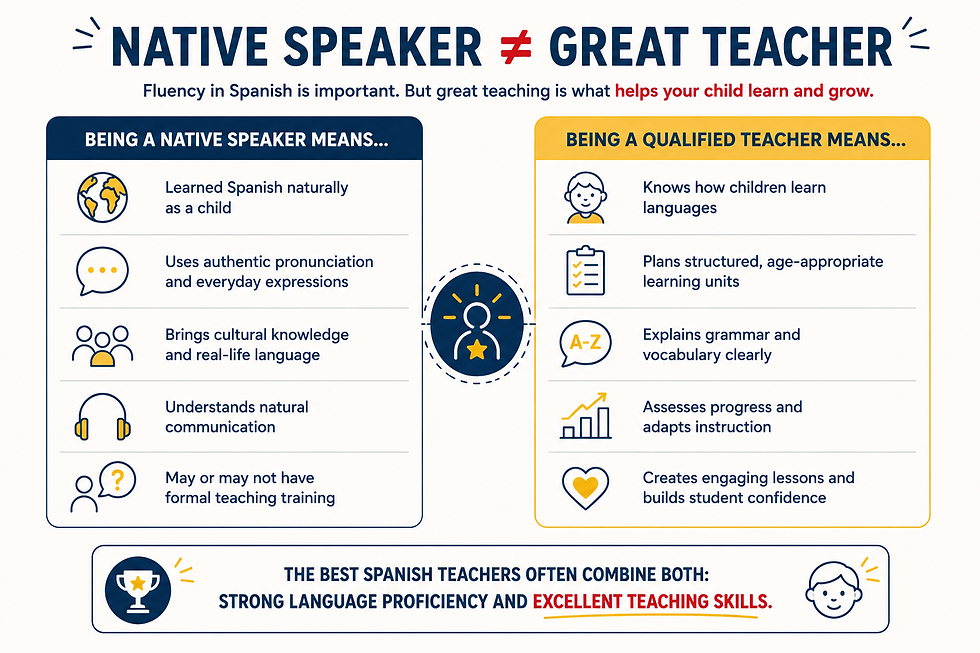
While native speakers often bring authentic pronunciation, natural expressions, and valuable cultural knowledge to their lessons, being fluent in a language is not the same as knowing how to teach it.
Think of it this way: Owning a piano doesn't make someone a piano teacher. Likewise, being an excellent pianist doesn't automatically mean they know how to teach a six-year-old to play. Teaching requires a different set of skills.
The same is true for language learning. An effective Spanish teacher needs to understand not only the language itself, but also how children learn, how to explain new concepts clearly, how to build confidence, and how to create lessons that keep students motivated and engaged.
In fact, the American Council on the Teaching of Foreign Languages (ACTFL) emphasizes that successful language teaching is centered on helping learners communicate meaningfully through well-planned instruction—not simply exposing them to a fluent speaker.
This doesn't mean native speakers aren't excellent teachers. Many are. Likewise, many non-native speakers become outstanding educators after years of study, professional training, and classroom experience.
The goal isn't to decide whether native speakers or non-native speakers are "better." Instead, it's to understand which qualifications truly matter when choosing someone to help your child learn Spanish.
Throughout this guide, we'll explore:
By the end of this article, you'll have a clear understanding of how to evaluate a Spanish teacher based on what truly helps children succeed—not simply on whether they learned Spanish as their first language.
Quick Answer: Is a Native Spanish Speaker Always the Best Spanish Teacher?
Not always.
Native speakers bring authentic pronunciation, cultural knowledge, and natural language use to the classroom. However, teaching Spanish effectively also requires knowledge of child development, language-learning methodology, lesson planning, assessment, and communication skills.
A highly qualified non-native Spanish teacher with strong language proficiency and professional training may provide a better learning experience than a native speaker with little or no teaching experience.
The ideal Spanish teacher combines:
Strong Spanish proficiency.
Excellent teaching skills.
Experience working with children or teenagers.
A structured curriculum.
The ability to create engaging, age-appropriate lessons.
In other words, language fluency and teaching expertise should go hand in hand.
👨👩👧 Parent Tip
Instead of asking only: "Is the teacher a native speaker?"
Try asking:
How many years have you been teaching children?
What curriculum do you use?
How do you measure progress?
How do you adapt lessons for different ages and learning styles?
The answers to these questions often tell you much more about the quality of instruction than a teacher's first language alone.

What Does "Native Speaker" Actually Mean?
The term native speaker is often used in advertisements for language schools and tutoring services.
You may have seen phrases such as:
Learn with native Spanish teachers!
100% native-speaking tutors!
Only native speakers!
But what does "native speaker" actually mean? In general, a native Spanish speaker is someone who acquired Spanish naturally during childhood, usually because it was the primary language spoken at home and in their community. They didn't study Spanish as a foreign language—they grew up using it every day to communicate with family, friends, teachers, and neighbors.
Because of this lifelong exposure, native speakers typically develop an intuitive understanding of the language. They naturally recognize what "sounds right," even if they have never formally studied grammar.
This lifelong experience gives native speakers many strengths, but it doesn't automatically make someone an effective teacher.
Teaching a language requires additional knowledge and skills that go beyond speaking it fluently.
There Isn't Just One "Native Spanish"
Another common misconception is that all native Spanish speakers speak the language in exactly the same way.
In reality, Spanish is one of the most widely spoken languages in the world, with more than 500 million native speakers across over 20 countries. As with English, regional differences in pronunciation, vocabulary, and expressions are completely normal.
For example, a teacher from Spain may use words that differ from those commonly used in Mexico, Colombia, or Argentina. Likewise, pronunciation and certain grammar structures can vary from one region to another.
These differences don't make one variety of Spanish more correct than another—they simply reflect the rich diversity of the Spanish-speaking world.
The Instituto Cervantes regularly highlights the global diversity of Spanish and its role as one of the world's most widely spoken languages.
For most children learning Spanish as a second language, becoming familiar with different accents and regional vocabulary can actually be an advantage. It prepares them to communicate with Spanish speakers from many different countries rather than expecting everyone to sound exactly the same.
Is Every Native Speaker Qualified to Teach?
Not necessarily.
Think about your own language. In the USA, most adults are native speakers of English, but that doesn't automatically mean they know how to teach a child to read, explain grammar, or plan engaging lessons. Teaching is a profession that combines subject knowledge with instructional skills.
An effective Spanish teacher needs to know how to:
explain new concepts clearly
adapt lessons to different ages and learning styles
build confidence in hesitant learners
provide constructive feedback
assess progress over time
create meaningful opportunities for communication
These are skills that teachers develop through education, training, and classroom experience—not simply by growing up speaking the language.
As the American Council on the Teaching of Foreign Languages (ACTFL) emphasizes, successful language instruction is built around helping learners communicate effectively through thoughtful, well-designed teaching practices.
What About Heritage Speakers?
You may also hear the term heritage speaker. A heritage speaker is someone who grew up with some exposure to Spanish at home—perhaps through parents or grandparents—but completed most of their education in another language, such as English.
Some heritage speakers are fully bilingual, while others understand Spanish well but feel less confident speaking, reading, or writing it.
Like native speakers, heritage speakers may become excellent teachers, but their teaching ability depends on their language proficiency, professional preparation, and experience—not on their background alone.
👨👩👧 Parent Tip
Don't assume that every native speaker has the same accent, teaching experience, or educational background.
Instead of asking "Are you a native speaker?", consider asking:
Which Spanish-speaking country are you from?
Have you taught Spanish to children before?
What ages do you specialize in teaching?
What training have you received in language teaching?
These questions provide a much clearer picture of whether a teacher is the right fit for your child.
How Fluent Should a Non-Native Spanish Teacher Be?
One of the biggest misconceptions about language learning is that only native speakers can become excellent language teachers.
In reality, many outstanding Spanish teachers learned Spanish as a second language themselves. Through years of study, immersion, professional development, and classroom experience, they achieved an advanced level of proficiency that allows them to teach confidently and accurately.
The important question isn't:
"Is the teacher a native speaker?"
Instead, parents should ask:
"How proficient is the teacher in Spanish?"
Fortunately, there is an internationally recognized way to answer that question:
Understanding the CEFR Levels
Many schools, universities, and language institutions around the world measure language proficiency using the Common European Framework of Reference for Languages (CEFR), developed by the Council of Europe.
Rather than focusing on how many grammar rules or vocabulary words someone has memorized, the CEFR measures what a person can actually do with the language in real-life situations.
It divides language proficiency into six levels.
CEFR Level | Description | Typical Ability |
A1 | Beginner | Can use simple words and phrases. |
A2 | Elementary | Can communicate in familiar everyday situations. |
B1 | Intermediate | Can handle routine conversations with some confidence. |
B2 | Upper Intermediate | Can communicate fluently in most everyday and professional situations. |
C1 | Advanced | Can express ideas naturally, accurately, and spontaneously in complex situations. |
C2 | Mastery | Demonstrates language skills comparable to a highly educated native speaker. |
What CEFR Level Should a Non-Native Spanish Teacher Have?
While there is no single international requirement for private tutors, we recommend looking for a teacher who has achieved at least a B2 level of Spanish, with C1 or higher being ideal.
At the B2 (Upper Intermediate) level, a teacher can:
Communicate fluently in most everyday situations.
Explain basic grammar and vocabulary accurately.
Hold natural conversations with students.
Read authentic Spanish materials with confidence.
Teach beginner and intermediate learners effectively.
For children who are just beginning to learn Spanish, a well-prepared teacher with a B2 level, strong teaching skills, and experience working with young learners can provide an excellent learning experience.
However, advanced learners, or learners preparing for language proficiency exams, many schools and educational institutions prefer teachers with C1 or C2 proficiency, as these levels reflect a greater ability to explain complex language, adapt to unexpected questions, and model more advanced communication.
The key takeaway is that language proficiency should always be considered alongside teaching ability. A teacher with excellent classroom skills and a solid command of Spanish is often a better choice than someone who speaks Spanish natively but has little experience teaching children.
How Can Parents Verify a Teacher's Spanish Level?
Unlike native speakers, who generally don't need to prove their language proficiency with an official certificate, non-native Spanish teachers can demonstrate their skills through internationally recognized language assessments.
Some of the most respected certifications include:
Certification | Organization | Measures |
DELE (Diplomas de Español como Lengua Extranjera) | Instituto Cervantes (on behalf of Spain's Ministry of Education) | Permanent certification of Spanish proficiency from A1 to C2. |
SIELE (Servicio Internacional de Evaluación de la Lengua Española) | Digital certification that measures current Spanish proficiency and is valid for five years. | |
ACTFL Oral Proficiency Interview (OPI) | Evaluates real-world speaking ability using ACTFL proficiency guidelines. | |
ACTFL Writing Proficiency Test (WPT) | Measures the ability to write effectively in Spanish. |
These certifications measure how well a person uses Spanish, but it's important to remember that they do not evaluate teaching skills. A language certificate shows proficiency in the language—not expertise in teaching it.
We'll explore the qualifications that prepare someone to teach Spanish effectively in the next section.
👨👩👧 Parent Tip
If a teacher is not a native Spanish speaker, ask whether they have an official language proficiency certificate.
A B2 certificate demonstrates upper-intermediate proficiency, while C1 or C2 indicates advanced language skills. Combined with teaching experience and training, these qualifications can help you feel confident that your child is learning from someone with a strong command of Spanish.
What Qualifications Should You Look for in a Spanish Teacher?
After learning about native speakers and language proficiency, many parents ask another important question:
"How do I know if a Spanish teacher is actually qualified to teach my child?"
This is an excellent question because speaking a language and teaching it are two different skills.
A teacher may have excellent Spanish, but that doesn't necessarily mean they know how to teach young learners, explain grammar clearly, or design lessons that help students make steady progress.
Likewise, a teacher with excellent classroom management skills still needs a strong command of the language to model correct pronunciation, answer questions confidently, and guide meaningful conversations.
The best Spanish teachers combine language proficiency, teaching knowledge, and practical experience.
Let's look at the qualifications that can help you evaluate a teacher with confidence.
1. A Strong Educational Background
Many excellent Spanish teachers begin with a university degree in education or languages.
Depending on the country, this may include degrees such as:
Bachelor's Degree in Education
Elementary Education
Modern Languages
Spanish Language or Hispanic Studies
Applied Linguistics
Foreign Language Education
These programs help future teachers understand:
how children learn
lesson planning
classroom management
language acquisition
assessment
child development
A university degree alone doesn't guarantee an outstanding teacher, but it provides a strong professional foundation.
2. Specialized Training in Teaching Spanish as a Foreign Language
Teaching Spanish to native-speaking children is very different from teaching Spanish to students who are learning it as an foreign language.
That's why many teachers complete specialized training in Spanish as a Foreign Language, often called ELE (Español como Lengua Extranjera).
These programs focus on topics such as:
second-language acquisition
communicative language teaching
age-appropriate instruction
lesson planning
assessment
teaching grammar in context
developing listening, speaking, reading, and writing skills
Many universities in Spain and Latin America offer postgraduate diplomas, certificates, and master's degrees in ELE.
The Instituto Cervantes also provides internationally respected teacher training programs and professional development opportunities for Spanish teachers around the world.
3. Teaching Credentials Around the World
One reason parents become confused is that there is no single worldwide teaching certificate for Spanish teachers.
Requirements vary depending on where a teacher works.
United States
Teachers working in public schools generally need:
a bachelor's degree
a state-issued teaching license
certification in world languages or Spanish
continuing professional development
Private tutors and language academies, however, often have different hiring requirements. Many demonstrate their qualifications through university degrees, teaching experience, professional development, and recognized language proficiency assessments.
Spain
Many Spanish teachers complete university degrees in education or languages and continue their preparation through ELE certification programs or master's degrees specializing in teaching Spanish as a foreign language.
Spain is also home to the DELE examinations, administered by the Instituto Cervantes on behalf of Spain's Ministry of Education. While the DELE certifies Spanish language proficiency, it is not a teaching license.
Latin America
Unlike Spain, Latin America does not have one certification that every Spanish teacher is expected to earn.
Instead, teachers typically qualify through:
university degrees in education
degrees in modern languages
teaching licenses issued by their country's education authorities
postgraduate diplomas
master's degrees
continuing professional development
Countries such as Colombia, Mexico, Argentina, Chile, Costa Rica, and Peru all prepare teachers through accredited universities and national education systems.
Rather than looking for one specific certificate from a particular country, it's more helpful to ask whether the teacher has formal preparation in teaching Spanish to language learners.
4. Experience Teaching Children Matters
Even the best academic qualifications cannot replace practical classroom experience. Teaching preschoolers is very different from teaching teenagers.
Young children often learn through:
games
songs
movement
storytelling
hands-on activities
Teenagers, on the other hand, may benefit from:
discussions
authentic texts
role-playing
projects
real-world communication
A teacher who regularly works with your child's age group is more likely to understand how to keep lessons engaging, adapt explanations, and build confidence over time.
5. Ongoing Professional Development
The best teachers never stop learning.
Language education continues to evolve as researchers discover more about how children learn languages, how technology supports instruction, and how teachers can create engaging learning experiences.
Many dedicated educators regularly participate in:
workshops
conferences
webinars
professional reading
curriculum training
educational communities
Organizations such as the American Council on the Teaching of Foreign Languages (ACTFL) and the Instituto Cervantes provide ongoing professional development that helps teachers continue improving throughout their careers.
Qualifications Checklist for Parents
When choosing a Spanish teacher, look for someone who has several of these qualities:
Qualification | Why It Matters |
✅ Strong Spanish proficiency | Models accurate, natural language. |
✅ Teaching qualification or education degree | Demonstrates knowledge of how students learn. |
✅ Experience teaching children | Lessons are appropriate for your child's age and development. |
✅ Structured curriculum | Provides clear progression instead of random activities. |
✅ Ongoing professional development | Shows a commitment to improving as an educator. |
Remember, you don't need to find a teacher who checks every box.
Instead, look for someone whose combination of qualifications, experience, and teaching style matches your child's needs.
👨👩👧 Parent Tip
Don't be afraid to ask a teacher about their background. Questions such as "What training have you completed?", and "How long have you worked with children this age?", are perfectly reasonable—and a qualified teacher will usually be happy to answer them.

What Native Spanish Speakers Naturally Bring to the Classroom
Throughout this guide, we've emphasized that being a native speaker is not the only qualification that matters when choosing a Spanish teacher.
However, that doesn't mean it isn't valuable.
Native Spanish speakers often bring unique strengths to the classroom that can enrich a child's learning experience in meaningful ways. Their lifelong relationship with the language allows them to model natural communication and introduce students to the cultural richness of the Spanish-speaking world.
These strengths become even more valuable when combined with strong teaching skills and experience working with children.
Let's take a closer look at what native speakers naturally contribute to the learning process.
Authentic Pronunciation
One of the greatest advantages of learning with a native Spanish speaker is hearing the language used naturally every day. Because they acquired Spanish during childhood, native speakers typically have intuitive pronunciation, rhythm, and intonation.
Children who regularly hear natural Spanish develop better listening skills and become more familiar with how the language sounds in real conversations. This doesn't mean students need to imitate one particular accent. Instead, consistent exposure to authentic speech helps them become more confident listeners and speakers over time.
Natural Vocabulary and Everyday Expressions
Languages are constantly evolving. New words, expressions, and idioms appear over time, while others become less common.
Native speakers naturally use vocabulary that reflects how people communicate in everyday life.
For example, they know which expressions are commonly used among family and friends, how conversations flow naturally, and which phrases sound more formal or informal depending on the situation.
These subtle language choices can be difficult to learn from textbooks alone.
Cultural Knowledge
Learning a language also means learning about the people who speak it. Native Spanish-speaking teachers often share personal experiences that bring the language to life.
They may introduce students to:
traditions and celebrations
food and regional cuisine
music and dance
children's literature
holidays
geography
daily life
customs and etiquette
These cultural connections help children understand that Spanish is more than vocabulary and grammar—it's a way of connecting with people from many different countries and backgrounds.
The ACTFL World-Readiness Standards emphasize that language learning includes developing intercultural understanding alongside communication skills, helping students use language in culturally appropriate ways. You can learn more on the ACTFL website.
Native Doesn't Mean "One Correct Spanish"
Some parents worry about choosing a teacher from one Spanish-speaking country over another.
In reality, there is no single "correct" Spanish accent.
Spanish is spoken across more than 20 countries, and every region has its own pronunciation, vocabulary, and expressions.
A child learning with a teacher from Colombia may hear different words than one learning with a teacher from Spain or Argentina.
These differences are completely normal and are similar to the differences between American English, British English, Australian English, or Canadian English.
Exposure to different varieties of Spanish can actually help children become more flexible and confident communicators as they grow.
👨👩👧 Parent Tip
If you're choosing a native Spanish-speaking teacher, ask which country they are from and whether they incorporate cultural lessons into their classes. Learning about traditions, music, stories, and everyday life can make Spanish more engaging and help children see the language as a bridge to new cultures—not just another school subject.

Final Thoughts: Choosing the Right Spanish Teacher for Your Child
Choosing a Spanish teacher isn't about finding someone who checks a single box.
A native speaker can offer authentic pronunciation, natural communication, and valuable cultural insights. A qualified teacher brings expertise in child development, language acquisition, lesson planning, and assessment.
The best choice is the teacher who can create a positive learning environment where your child feels confident, engaged, and motivated to communicate in Spanish.
As you compare teachers, look beyond labels like native speaker or non-native speaker. Instead, consider the complete picture:
Spanish language proficiency
Teaching qualifications
Experience working with children
A structured curriculum
The ability to make learning enjoyable and meaningful
Every child learns differently, and the right teacher is the one whose skills, teaching style, and experience match your child's unique personality and goals.
Still Not Sure Which Spanish Teacher Is Right for Your Child?
Choosing a tutor can feel overwhelming, especially if you're comparing several programs or aren't sure which questions to ask.
Our complete guide, How to Choose the Best Spanish Tutor for Your Child or Teen, walks you through everything you should consider before making a decision—from qualifications and teaching style to curriculum, class format, and long-term learning goals.
Experience Our Teaching Approach with a Free Trial Lesson
Reading about teaching methods is helpful—but the best way to know if a teacher is the right fit is to see them in action.
At Helping Your Kids Learn Spanish, we believe every child deserves a learning environment where they feel encouraged, challenged, and excited to communicate in Spanish.
That's why we offer a free trial lesson. During the session, your child can meet their teacher, experience our interactive teaching style, and discover what learning Spanish with us is like—without any obligation.
Whether your child thrives in one-on-one lessons or would enjoy learning alongside peers in one of our small group classes for teens, we're happy to help you find the option that best supports their learning goals.


Comments